Bruce Liu Explores Night, Moonlight and Inner Worlds on Lunaris
“Liu’s interpretation blended poetic sensitivity with technical finesse”
Bachtrack, reviewing Tchaikovsky’s The Seasons at Carnegie Hall, January 2025
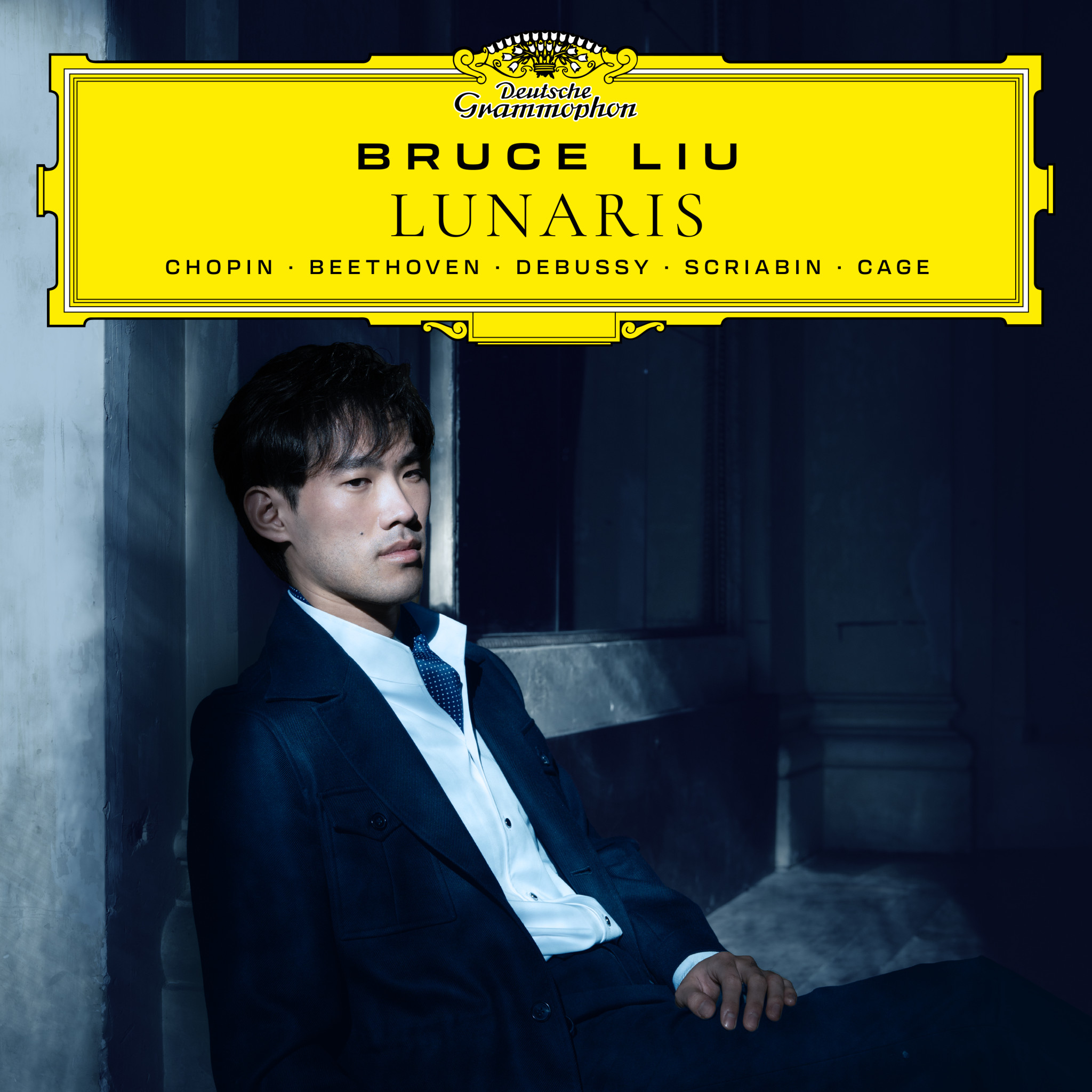
Lunaris is a diverse and poetic exploration of the symbolic potential of night-time
It traces a narrative arc from Chopin’s Nocturne, Op. 27 No. 2 to Cage’s Dream,
via music by Beethoven, Debussy and Scriabin, among others
The album will be released on 7 August 2026
“For me, Lunaris is about a state of being. It is a nocturnal atmosphere
and a space for introspection and quiet radiance”
Bruce Liu
Chinese-Canadian pianist Bruce Liu won the International Chopin Piano Competition in 2021, aged just 24, signing with Deutsche Grammophon the following year. Since then, exemplary performances at the world’s most prestigious venues and acclaimed recordings for the Yellow Label have established him as one of the best-known classical artists of his generation. His debut studio album, Waves: Music by Rameau · Ravel · Alkan, was followed by The Seasons, which garnered similarly glowing reviews.
Now Liu is set to showcase both his versatility and his inventive approach to programming with his latest album, Lunaris, a richly varied collection of works associated with night-time and the moon. “The night is the moment when reflection and creative energy meet,” notes the pianist. “The idea of Lunaris came to me as a word that sounds both familiar and mysterious. The root, ‘luna’, immediately evokes the moon, the night and a certain kind of light that is indirect and deeply intimate. It describes those hours when the external world becomes quiet and the inner world opens a space for imagination, for sensitivity, and for a different perception of time.”
Alongside core repertoire works such as Beethoven’s “Moonlight” and “Waldstein” Sonatas, Scriabin’s Fourth Sonata and Debussy’s Rêverie, the album includes gems by J.S. Bach, Mompou, Cage, Ligeti and Danish singer-songwriter Agnes Obel. Lunaris will be released on CD, on vinyl and digitally on 7 August 2026. Both the vinyl and digital versions include two additional tracks: “Hivernale” from Hahn’s Le rossignol éperdu and the first of Schoenberg’s 6 kleine Klavierstücke. A first digital single, Rêverie, will be available digitally from 29 May, with the final movement from the “Moonlight” Sonata following on 26 June, and Mompou’s Glossa sobre “Au clair de la lune” out on 17 July.
In the months leading up to the Chopin Competition, Bruce Liu found that many of his best musical ideas came to him in his dreams, and now, as a touring artist, he frequently finds himself working late at night. “It’s often the only time that silence and concentration, in the sense of timelessness, are possible,” he says. It was this experience of working in the small hours that in part inspired the idea of an album about moonlight and dreams, darkness and daybreak.
Bruce was also influenced by the poetry of Baudelaire and Verlaine, the nocturnal landscapes of Friedrich, the interiors of Hammershøi, Dalí’s The Persistence of Memory and, in particular, Magritte’s The Empire of Light. “During the whole process I was thinking in very visual terms,” he explains. “The Magritte immediately felt like a visual mirror of the album. The coexistence of night and day, and the space where light can exist within the night, became a very strong poetic key to the concept. In all this, what matters to me is that the inner landscape becomes infinite.”
Liu based Lunaris on a central “constellation” of works by Beethoven, Scriabin and Chopin, adding further pieces that resonated with them in terms of colour and atmosphere. The resulting sequence of “inner landscapes” forms a clear trajectory “from the human, intimate world towards something luminous, from earth to inner cosmos”.
He opted to open the album with Chopin’s Op. 27 No. 2 because, through its key signature, it shares a “gravitational centre” with the following work, the “Moonlight” Sonata – D flat and C sharp are enharmonic equivalents, “but the emotional transformation between them feels like a second creation”. Then, after Debussy’s Rêverie, comes the shift from the human to the “transparent and impersonal” aspect of night-time, with Siloti’s arrangement of a Bach prelude.
Sharing the latter’s sense of luminosity and suspension are Agnes Obel’s Tokka – a work whose repeating notes conjure “a kind of timeless breathing” – and Mompou’s two equally delicate takes on the folk song Au clair de la lune. “In an album that moves between very well-known works, it was important to have these moments of intimate revelation,” says Liu.
Both the “Waldstein” (also known as the “Aurora”, or “Dawn”) and Scriabin’s Fourth Sonata take us out of darkness and into the light. Liu had always wanted to record the Scriabin: “Although it’s not a nocturnal piece in the traditional sense, it represents that moment when the nocturnal world opens into something cosmic and visionary.”
Lunaris ends with Cage’s hypnotic Dream: “After the whole journey of the album, Dream feels like a place where gravity fully disappears. So I chose it as the final piece because it does not close the journey but leaves it open.”
Bruce Liu will perform repertoire from Lunaris at a number of recitals this summer: full touring details can be found here.
![Bruce Liu - Tchaikovsky: 6 Romances, Op. 16: No. 1, Lullaby (Cradle Song) [Version for Piano]](https://images.universal-music.de/img/assets/610/610521/4/2048/bruce-liu-tchaikovsky-6-romances-op-16-no-1-lullaby-cradle-song-version-for-piano.jpg "TCHAIKOVSKY Lullaby, Op. 16: No. 1 / Bruce Liu")